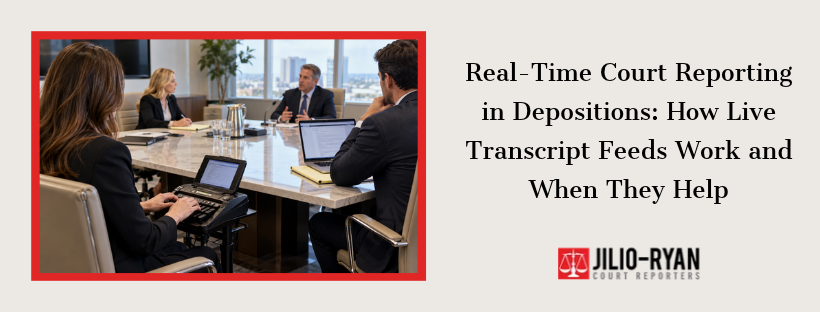
A witness answers a question about a contract date, and across the table an attorney glances at a laptop to see the exact words appear before the next question is even formed. That is real-time court reporting. The reporter writes testimony on a stenographic machine, and software turns those strokes into text that streams to authorized screens as people speak. Used well, it changes how a legal team listens, follows up, and prepares. Used carelessly, it creates confusion about what counts as the record.
What Is a Real-Time Transcript?
A real-time transcript is a live text stream of testimony, delivered to a laptop, tablet, or phone during the deposition. A court reporter, the neutral professional who creates the official record of sworn testimony, writes on a steno machine, and software translates the keystrokes into English almost instantly. Reporters commonly use software such as LiveNote, and the reporter controls who can connect. Attendees view the text on their own devices, and many programs let them highlight passages, add notes, and flag testimony to revisit later. The live text is a working view, not the finished product. It is unedited, so it can contain misspellings, untranslated words, or missing punctuation. The certified transcript is produced afterward, once the reporter has reviewed and corrected the record.
What You Need to Receive a Live Feed
Real-time reporting depends on three things: a reporter whose equipment and training support live output, a device with compatible viewing software, and a dependable connection between them. Not every reporter writes in real time, so the request should be made when the date is set. Ask how the feed will be delivered, whether through a cable, a local network, or a secure online link. Remote attendees usually receive a link. Test the setup before testimony begins, because a short check beforehand avoids a late start with a full room waiting on one laptop. Confirm these points before the day:
- Whether the assigned reporter provides real-time output
- Which viewing software and device types are supported
- How remote attendees will connect, and who receives access
- Whether real-time is priced as an add-on to the standard service
- Who may view the feed if a protective order applies
How a Live Feed Changes Questioning
The most immediate benefit is accuracy under pressure. When a witness gives a long answer, the examining attorney can scroll back to confirm the exact wording before choosing a follow-up. That reduces the number of read-backs, which interrupt the flow of testimony. Teams with several lawyers benefit as well. A second attorney can mark an inconsistency for the examiner to revisit while the first keeps questioning, without passing notes across the table. Live text also helps people who miss words in a noisy room, work with a strong accent, or join through a weak audio connection. Seeing the words gives them a second channel to follow the testimony. Trial teams find another use. At the end of a long day, the feed lets the team pull exact quotes for cross-examination outlines instead of waiting for the full transcript. Having those lines on hand that evening speeds up preparation for the next witness.
When Real-Time Is Worth Requesting
Not every deposition needs it. A short, straightforward session with one witness may not justify the added cost. The value rises with complexity.
| Situation | Why a live feed helps |
| Expert witness with technical vocabulary | Terms can be checked against the text as they are spoken |
| Several attorneys or locations | Everyone follows the same words at the same moment |
| Long testimony with many documents | Key passages can be flagged and found quickly |
| Evasive or shifting answers | Exact wording is on screen when follow-up questions are built |
| Participants who need text alongside audio | Words are visible as well as heard |
How Reporters Prepare for Live Output
Behind every clean live feed is preparation. Reporters build personal dictionaries that tell the software how to translate their shorthand strokes, and they add the names, places, and technical terms of each case. Without that work, an unfamiliar word appears as a string of letters. That is why advance materials matter. A witness list, a glossary, and the key documents give the reporter time to load terms ahead of the session. Sending them a few days early makes the live text cleaner and the final transcript easier to finish.
Habits That Keep the Feed Accurate
Live text is only as clear as the testimony it follows. A few habits help everyone in the room:
- Speak one at a time, since overlapping voices cannot be written accurately.
- Spell unusual names and technical terms the first time they come up.
- Answer in words rather than gestures, and wait for each question to finish.
- Pause when the reporter asks for a repeat, which protects the record and is not a criticism.
Real-Time Reporting for Remote Attendees
Live feeds work well alongside remote participation. Attendees who join by video can receive the text through a secure link, so a colleague in another city follows the same words as the room. Pairing the feed with live video streaming lets remote counsel read and watch at once. Share the access list early, since each connection needs to be set up and approved before testimony begins.
What a Live Feed Does Not Replace
The certified transcript remains the official record. In California, when testimony is recorded stenographically, the deponent generally has 30 days after notice that the original transcript is ready to review it and change answers under Code of Civil Procedure section 2025.520. That window applies to the certified original, not the live stream. Never quote the raw feed in a filing or read from it as though it were the record. Quote the certified version, and confirm the requirements that apply to your case with your attorney. Treat the feed as confidential as well. Share access only with people entitled to see the testimony, and check whether a protective order limits who may view it.
Putting the Transcript to Work Afterward
Once the certified transcript is ready, flags made during testimony become a starting point for deposition summaries, motion work, and witness comparisons. The passages you marked live save hours of rereading. Secure online and mobile transcript tools let teams highlight, annotate, and send portions of a transcript to colleagues from a phone, tablet, or desktop. Pairing in-room flags with those tools keeps the path from testimony to analysis short. Firms handling several witnesses at once can fold real-time coverage into broader deposition services, so every session follows the same setup.
Add a Live Feed to Your Next Deposition
If a live transcript would help on an upcoming case, raise it early so the right reporter is assigned. Jilio-Ryan offers real-time depositions through its Tustin, California office. Share your date, location, and attendee count through the Contact Us page, and the team will walk through the setup your case needs.
FAQs
Is the live feed the official transcript?
No. The feed is unedited and uncertified. The official record is the certified transcript the reporter produces after the deposition.Can remote attendees see the feed?
Often, yes, through a secure link, when it is requested in advance. Confirm who will receive access before the day.Does real-time reporting slow the deposition down?
It should not. The reporter writes at the same pace. Speakers should still talk one at a time and clearly, because unclear speech affects the text.Can the witness read the feed?
Only if the parties agree and the reporter allows it. Some examiners prefer that the witness not see the screen, so settle the question beforehand.